Financial Independence for Private Operators
Operator financial independence intersects with systems that classify entities, impose filing and tax rules, expose public records, and define creditor remedies; those systems do not certify financial independence.
Financial independence for an operator crosses business and personal record systems. This hub separates what those systems establish from what they do not measure about cash, wealth, solvency, or retirement readiness.
For ICP v5.4 acquisition cohorts multi-entity-mid, volume-reseller, wy-multi-norsl-high, nonwy-multi-norsl-high, wy-single-norsl-high, nonwy-single-norsl-high, and international-high-ltv.
Covers: visible, searchable, actionable, verified, constrained
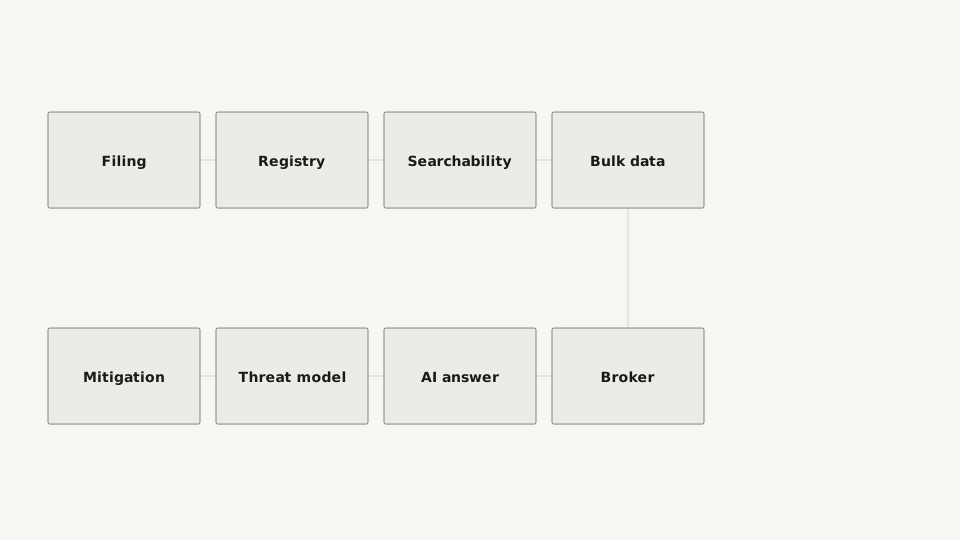
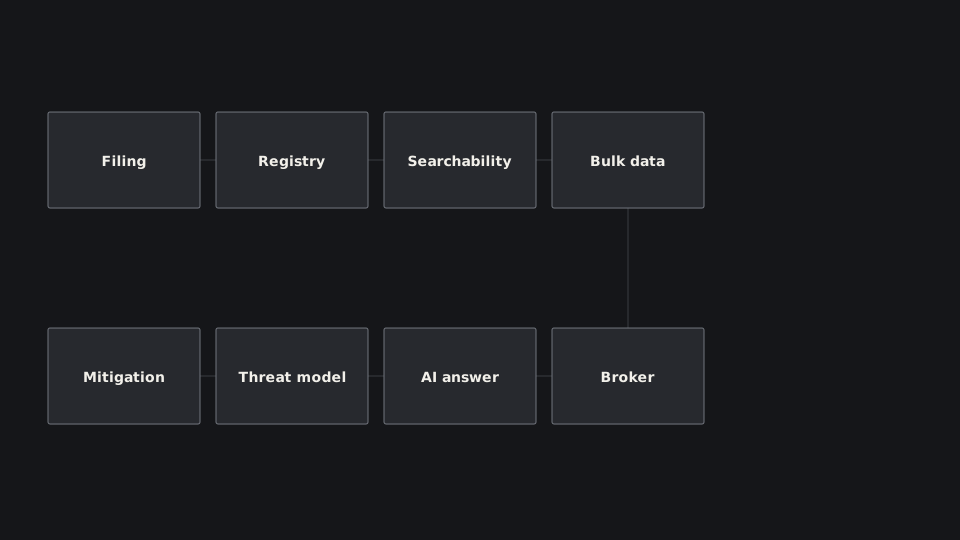
Figure 1. Eight connected stages trace a generic filing through registry, searchability, bulk data, broker and AI answer to a threat model and mitigation, with no factual annotations.
Source: none (concept)
Start here
Where does operator financial independence meet public systems?
It meets the systems that classify an entity, impose filing or tax rules, define a creditor remedy, and expose official records, but none of those systems certifies financial independence.
Use this hub to separate a rule, classification, filing, remedy, or public-record observation from conclusions the evidence cannot support. It does not calculate a retirement number, forecast returns, rank jurisdictions, prescribe a structure, or estimate a person's wealth.
Choose the operator-system question
Each canonical page owns one evidence boundary: entity structure, rule-constrained liquidity, asset location versus legal protection, or public inputs that can contribute to a wealth inference.
- Entity Structure and Financial Independence asks which entity-capacity, federal-classification, and state holding-entity rules can support or complicate an operator's structure.
- FIRE vs Operator Liquidity asks which public tax and entity rules constrain an operator's decision calendar while refusing to treat those records as proof of available cash.
- Asset Location vs Asset Protection distinguishes where an asset is held from the cited creditor-remedy, disclosure, or tax rule that applies.
- Private Operator Net-Worth Privacy maps public registry, UCC, address, and land-trust inputs without estimating value, equity, cash, debt, or net worth.
What do the named systems verify?
They verify only the cited rule, classification, filing field, query vector, displayed record field, or remedy posture within that source's own scope.
- Entity Structure uses federal-classification, state holding-entity, and entity-capacity families to establish the named classification, rule scope, filing obligation, or permitted role.
- Operator Liquidity uses tax and holding-entity families to establish rule scope, treatment, effective period, and filing obligation, not balances, receivables, distributable cash, debt service, owner draws, or runway.
- Asset Location uses international-vehicle, domestic remedy, land-trust, and redaction families to keep title, disclosure, tax treatment, and creditor remedy as separate predicates.
- Net-Worth Exposure uses business-registry, UCC, address, beneficial-ownership, and land-trust families to establish supported public query or display fields, not beneficial value or current ownership beyond the record's field.
What do the named systems retain?
Retention is not measured by this dataset: the current cell families do not contain an official record-retention field for the authorities, registries, portals, or courts they describe.
- A filing obligation is not a retention period, and an effective period is not a statement about how long an authority keeps a submitted record.
- A public, searchable, visible, or downloadable field describes access at the checked source; it does not establish how long the underlying system retains the record.
- The redaction field rd.duration measures the duration of a protection, not the retention period of the source record.
- Use the Source Registry and the child page's correction route when the required retention fact is outside the measured substrate.
Canonical Independence research
These four guides define this hub's core research boundaries: entity structure, operator liquidity, asset location, and public inputs that can contribute to a net-worth inference.
Which questions stay with Protection?
Tax residency, jurisdiction tax regimes, Puerto Rico tax treatment, and creditor-remedy comparisons remain Protection-owned evidence even when an Independence page links to them.
- Use Residency and Citizenship Programs for the Protection-owned residency-program matrix.
- Use Tax Regimes by Jurisdiction for the Protection-owned tax-regime matrix; do not convert its fields into a retirement or cash-flow model.
- Use Asset Protection Trusts by Jurisdiction, LLC Charging-Order Protection by Jurisdiction, and Offshore Asset-Protection Vehicles by Jurisdiction for their cited remedy and vehicle fields.
- Puerto Rico tax and Act 60 treatment remains Protection-owned; no replacement canonical is linked here until that silo publishes one.
How should freshness and scope be read?
Use the oldest checked or captured date among facts rendered on the child page, and keep every conclusion inside that source's jurisdiction, vehicle, record system, field, and typed-unknown boundary.
Do not carry one jurisdiction's rule into another, turn a permitted entity role into a tax classification, turn title location into creditor protection, or turn a public filing into proof of value, liquidity, solvency, ownership beyond the recorded field, or financial independence. This hub is not legal, tax, investment, retirement, or asset-protection advice.
Datasets and mirrors
- Federal Entity Classification
- Tax Regimes by Jurisdiction
- Asset-Protection Trusts by Jurisdiction
- LLC Charging-Order Protection by Jurisdiction
- Offshore Asset-Protection Vehicles by Jurisdiction
- Business Registry Searchability by State
- UCC Filing Searchability and Debtor Exposure by State
- Land Trust Privacy by State: What Deeds, Tax Rolls, and Disclosure Rules Show
- Property-Record Redaction by State: Eligibility, Covered Records, and Official Requests
- Source Registry