Hardened Mobile Operating Systems: Isolation, Boot, and Updates
A hardened mobile operating-system model can isolate applications, verify each stage of the boot chain, deliver an update to an unused partition, and preserve a fallback path. Those mechanisms are source-scoped, and they do not establish universal service removals, compatibility, or security guarantees.
Not legal advice. This page is research, not compliance guidance.
How does application isolation contribute to mobile operating-system hardening?
In one documented application-sandbox model, each application receives a unique user ID, runs in its own process, and is isolated through kernel-enforced process controls; by default, applications cannot interact with one another and have limited operating-system access.
The documented model separates application resources through a user-based protection mechanism. Each application receives a unique user ID and runs in its own process. The user ID establishes a kernel-level application sandbox, and the kernel enforces security between applications and the operating system at the process level.
In this model, applications cannot interact with one another by default and have limited access to the operating system. No universal inventory of service dependencies that hardening may remove or change is established here.
This is one documented application-isolation model, not a universal definition of a hardened mobile operating system. It establishes the isolation mechanism without claiming that every operating system uses the same user-ID, process, or service-dependency design.
- Application identity: each application receives a unique user ID in the documented model.
- Process boundary: each application runs in its own process.
- Enforcement boundary: the kernel enforces security between applications and the operating system at the process level.
- Evidence boundary: no universal inventory of removed or changed service dependencies is established.
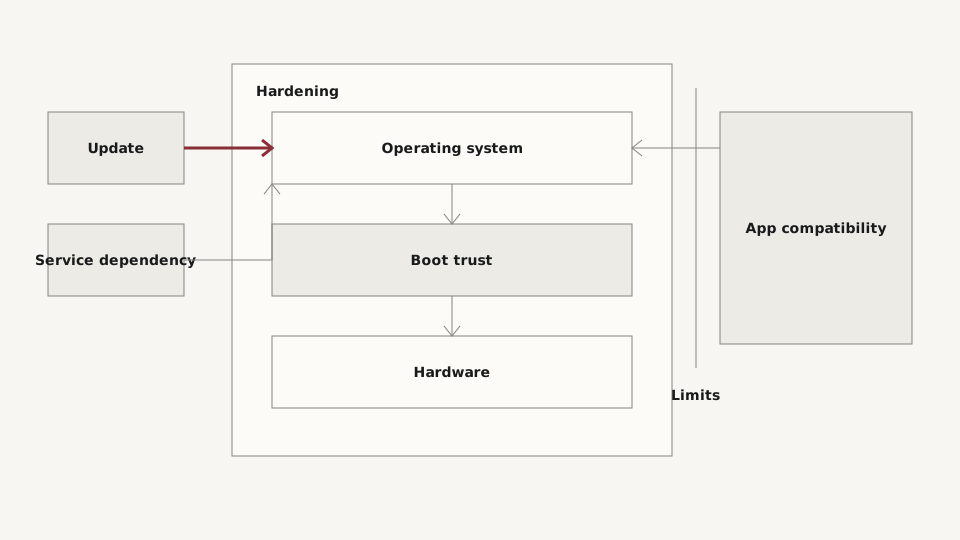
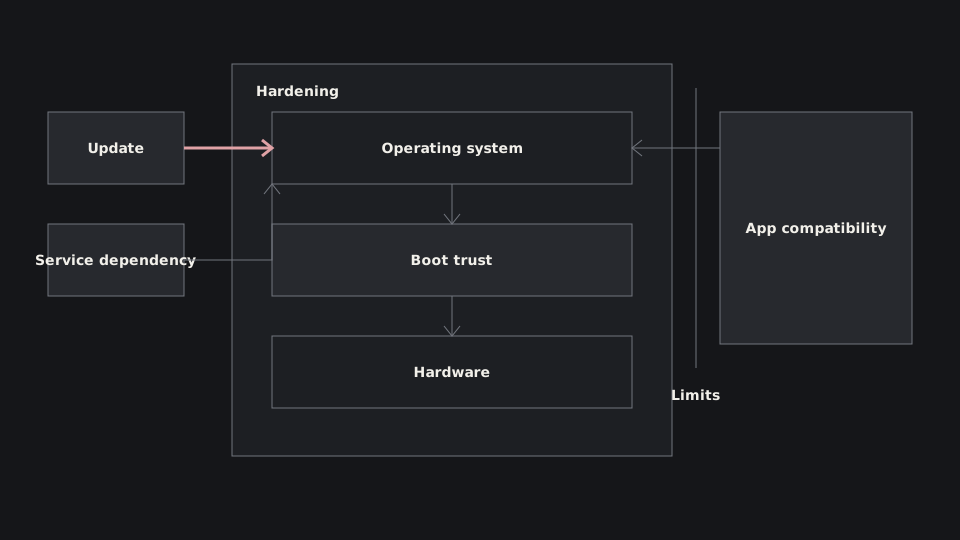
Figure 1. A layered mobile-system structure includes hardware, boot trust, operating-system updates, service dependencies, app compatibility, hardening and a limits boundary.
Source: none (concept)
What do verified boot and A/B updates each do?
One documented verified-boot model checks a chain of trust from a hardware-protected root through later boot stages. Separately, a documented A/B update flow writes an update to the unused partition and, if the update is applied successfully, asks the bootloader to select it at reboot with fallback if the new operating system does not boot.
One documented verified-boot model begins with a hardware-protected root of trust. Trust then extends through the bootloader and verified partitions, with each stage checking the integrity and authenticity of the next before handing over execution.
Rollback protection adds a version boundary. In this model, ensuring devices only update to newer operating-system versions helps prevent a possible exploit from becoming persistent. This is a description of one documented boot model, not a claim that every mobile operating system implements the same chain.
A documented A/B update flow checks package servers for an available update, gives the update engine an HTTPS package URL, and streams the package's raw blocks to the currently unused partition. After a successful update, the update engine tells the bootloader to select the new operating system on the next reboot. If the new operating system fails to boot, the bootloader falls back to the old one.
- The verified-boot chain starts at a hardware-protected root of trust.
- Each boot stage verifies the integrity and authenticity of the next stage before execution passes to it.
- The update engine streams an available update to the currently unused partition.
- After success, the bootloader selects the new operating system at reboot and falls back to the old one if the new one does not boot.
What compatibility boundary can a hardened mobile operating system retain?
In one documented example, the compatibility layer's developer states that it provides near-complete compatibility for dependent applications while leaving a small subset of privileged functionality unavailable and excluding some inherently privileged functions that the layer cannot provide.
Compatibility can be broad without being complete. In one documented example, the compatibility layer's developer describes the layer as close to fully functional and states that it provides near-complete compatibility with the application ecosystem that depends on the services it supplies.
The same developer states two limits. A small subset of privileged functionality remains unavailable because it has not yet been ported to other approaches with the compatibility layer, and some functionality is inherently privileged and cannot be supplied as part of the compatibility layer.
This is one source-scoped example. It does not establish a universal compatibility rate, compare products, or support a recommendation. No broader compatibility claim is inferred from it.
- Developer-stated scope: near-complete compatibility for applications that depend on the services supplied by the layer.
- Unavailable subset: some privileged functionality has not yet been ported to other approaches with the compatibility layer.
- Inherent boundary: some privileged functionality cannot be provided by the compatibility layer.
- Evidence limit: one example does not establish a universal compatibility rate or product recommendation.
What do these hardening mechanisms not guarantee?
These documented mechanisms do not establish a universal hardening guarantee: application isolation describes one sandbox model, verified boot describes one source-scoped trust chain, and the compatibility example retains unavailable privileged functions.
Application isolation establishes a default process boundary in one documented model. This page makes no claim that every mobile operating system uses the same design, and no universal inventory of service dependencies removed or changed by hardening is established here.
Verified boot establishes a source-scoped chain of trust in which each boot stage verifies the next. This page states no general security guarantee beyond that documented trust chain.
Compatibility remains bounded by privilege. The documented example leaves a small subset of privileged functionality unavailable and states that some inherently privileged functions cannot be provided through its compatibility layer. These are the limits the cited sources support; no broader limits list, ranking, or recommendation is inferred.
- Isolation limit: one documented sandbox model is not a universal operating-system design.
- Service-dependency limit: the evidence does not inventory every dependency changed or removed by hardening.
- Boot-trust limit: one verified-boot chain does not create a general security guarantee.
- Compatibility limit: some privileged functions remain unavailable or cannot be provided through the documented layer.